If you have ever searched for a career in business, finance, supply chain, accounting, or enterprise technology, you have probably come across the term SAP.
At first, SAP can feel confusing. Some people say SAP is software, while others say SAP is an ERP system. You may also hear terms such as SAP S/4HANA, SAP FICO, SAP MM, SAP ABAP, and SAP consultants.
So, what exactly is SAP, and how does it relate to ERP? Let’s break it down in a simple way.
What is ERP?
ERP stands for Enterprise Resource Planning. An ERP system is business management software that helps an organization manage and connect its day-to-day operations. These operations can include accounting, purchasing, project management, risk management, inventory, and supply chain activities.
The main purpose of an ERP system is to bring different business processes together into one integrated system. Imagine a company where the finance department uses one software, the sales team uses spreadsheets, the warehouse uses another system, and HR stores information somewhere else. This can create separate data silos and make it difficult for departments to work with the same information.
An ERP system helps solve this problem by connecting important business functions.
- Finance can access financial data.
- Sales teams can manage customer orders.
- Purchasing teams can track suppliers.
- Inventory teams can monitor stock.
- Inventory teams can monitor stock.
Management can view business information in one place.
This creates what is often called a single source of truth centralized system where different departments can work with consistent information.
A simple way to understand ERP is to think of it as the brain and nervous system of a company. Different departments perform different jobs, but they are connected through the same system.
What is SAP?
SAP stands for Systems, Applications, and Products in Data Processing.
SAP is also the name of the company that develops enterprise software. In a business environment, when people say they “use SAP,” they are usually referring to the enterprise software solutions created by SAP, such as SAP S/4HANA.
The easiest way to understand the relationship is: ERP is the type of system. SAP is one of the companies that provides an ERP system.
For example, a smartphone is a type of product, while different companies manufacture different smartphones. Similarly, ERP is a category of business software, and SAP is one of the major companies providing ERP solutions.
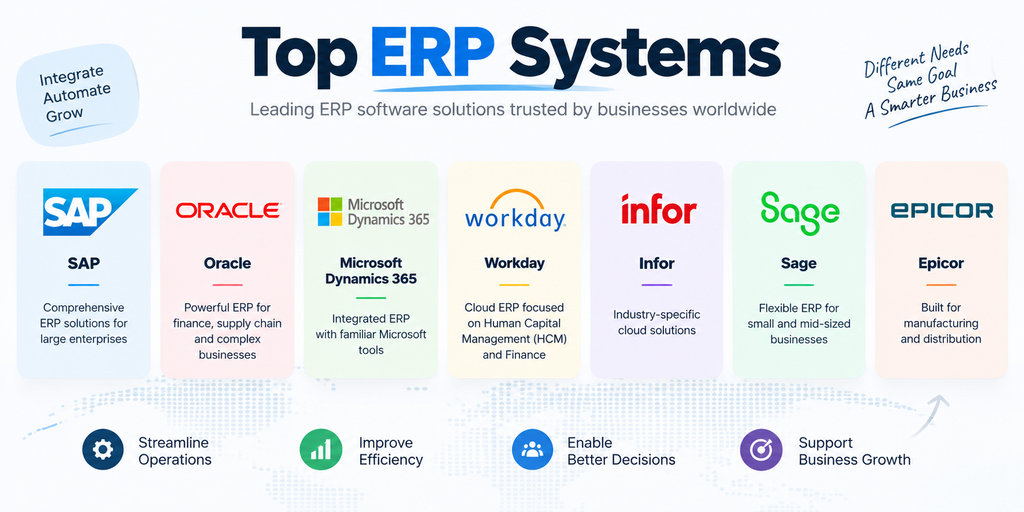
There are also other ERP providers, including Oracle, Microsoft Dynamics, Workday, Infor, Sage, and Epicor. Different systems may focus on different industries, company sizes, and business requirements.
Why Do Companies Use SAP?
Large organizations handle enormous amounts of information every day.
- Customer orders
- Purchase orders
- Supplier information
- Employee data
- Payroll
- Inventory transactions
- Manufacturing activities
- Financial reports
Managing all of this information through separate systems can become difficult.
SAP helps organizations connect many of these processes through an integrated enterprise system.
For example, imagine a manufacturing company receives a new customer order. The sales team records the order. The inventory team needs to check whether the required materials are available. The production department may need to plan manufacturing activities. Finance may need to create invoices and record the financial impact.
Instead of every department manually transferring information between different systems, an integrated ERP system helps connect these business processes. This is one of the main reasons enterprise software has become important for large organizations.
Why is SAP So Popular?
SAP is widely known for its broad functionality and ability to support complex business operations.
One important reason is the large number of business processes that SAP can support. Organizations may use SAP across areas such as finance, human resources, manufacturing, and supply chain operations.
SAP is also designed to support organizations operating at a large scale. Global companies may operate across multiple countries and need systems capable of handling large transaction volumes and different local business requirements.
Another important factor is the SAP ecosystem. The platform has a large network of consultants, implementation partners, developers, and professionals who work with SAP systems.
SAP also continues to focus on newer technologies. SAP S/4HANA, for example, is associated with SAP’s newer generation of enterprise software and its use of SAP HANA technology for areas such as real-time analytics and speed.
SAP Modules: Different Areas of a Business
One reason SAP can support different types of business processes is its modular structure. Different modules focus on different areas of an organization.
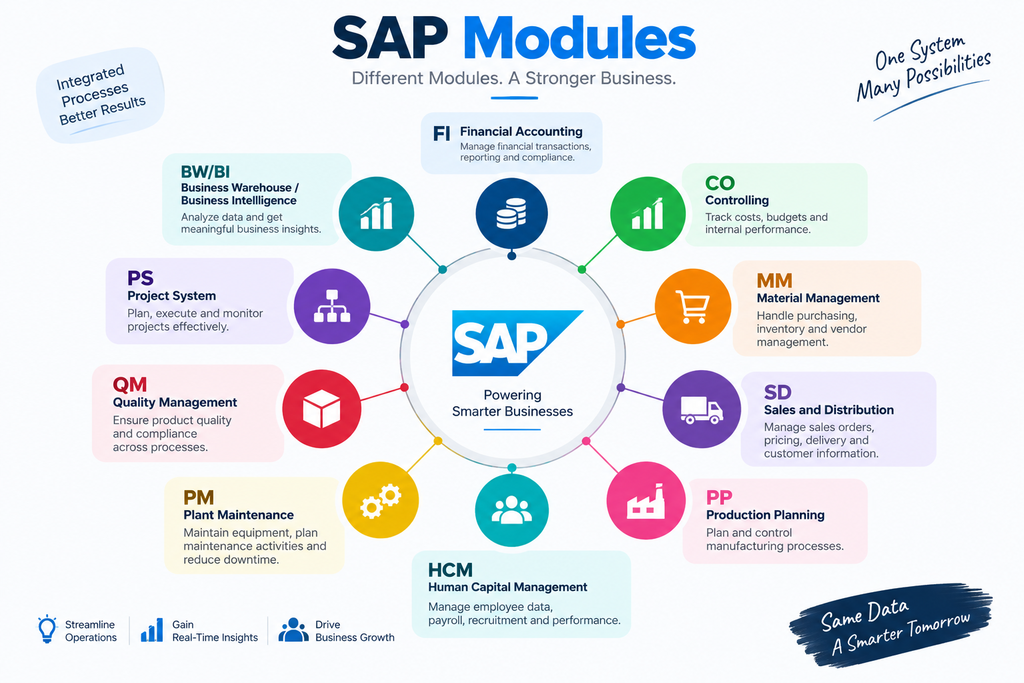
Finance and Controlling
Finance-related SAP roles may involve accounting, taxes, cost tracking, and budgeting.
Supply Chain
Supply chain-related processes can include purchasing, inventory, warehousing, sales, and billing.
Human Resources
HR-focused systems can support employee data, payroll, recruitment, and performance-related activities.
Production
Production-related processes can involve manufacturing planning and scheduling.
This means SAP professionals often specialize in a particular business or technical area instead of learning every part of the system.
SAP Careers: Functional vs Technical
SAP careers are generally divided into two broad areas: functional roles and technical roles.
Functional Consultants
Functional consultants focus more on the business side. They understand how a particular department or business process works and help configure the SAP system based on those requirements.
For example, someone with a finance background may work with finance-related SAP processes, while someone with supply chain experience may focus on purchasing or inventory processes.
Technical Consultants
Technical consultants focus more on programming, system infrastructure, databases, and performance.
- SAP ABAP Developer
- SAP BASIS Consultant
- Data Analyst / BI professional
These roles involve areas such as custom development, system management, databases, security, reporting, and analytics.
SAP and ERP: The Simple Difference
For beginners, the difference can be summarized like this:
ERP is a category of business management software, while SAP is a company and provider of enterprise software. ERP describes the concept of an integrated business system, while SAP provides ERP solutions such as SAP S/4HANA. Many companies offer ERP systems, and SAP is one of the major ERP providers.
So, it is not technically correct to say that SAP and ERP are completely different things.
SAP is an example of an ERP solution.
Final Thoughts
SAP is a major part of the enterprise technology world, but understanding the basics is not as complicated as it initially seems.
Start with the main idea: ERP helps organizations connect and manage their business processes. SAP is one of the major providers of ERP software.
Once you understand this foundation, topics such as SAP modules, SAP careers, SAP implementation projects, and SAP S/4HANA become much easier to understand.
For students and professionals interested in SAP, the best starting point is to first understand how businesses work. Finance, purchasing, sales, inventory, manufacturing, and human resources are all important parts of an organization—and ERP systems help connect these processes.
SAP is not just about learning software screens or transaction codes. At its core, it is about understanding how a business operates and how technology can help different parts of that business work together.
Frequently Asked Questions About SAP
1. What is SAP in simple words?
SAP is enterprise software that helps companies manage and connect different business activities such as finance, sales, purchasing, inventory, human resources, and other operations through an integrated system.
2. What is the difference between SAP and ERP?
ERP is a type of business management system used to integrate different business processes. SAP is one of the major companies that provides ERP software and enterprise solutions. In simple terms, ERP is the concept, while SAP is a software provider and ERP solution provider.
3. Is SAP difficult to learn for beginners?
SAP can feel complex at the beginning because it is connected to real business processes. However, beginners can start by understanding the basics of ERP, business processes, and the purpose of different SAP modules. Learning one area step by step is usually easier than trying to understand the entire SAP system at once.
4. Which SAP module is best for beginners?
There is no single SAP module that is best for everyone. The right choice depends on your educational background, work experience, and career interests. For example, finance-related backgrounds may be more interested in finance and controlling, while supply chain professionals may focus on purchasing, inventory, or sales processes. Technical professionals may explore areas such as SAP ABAP, BASIS, or data and analytics.
5. Is SAP a good career option?
SAP and ERP careers offer opportunities in both functional and technical roles. Because large organizations use enterprise systems to manage important business processes, professionals with relevant business knowledge and SAP skills can work in areas such as finance, supply chain, human resources, development, system administration, and analytics. The best approach is to choose an SAP career path based on your existing skills and the type of work you want to do.